
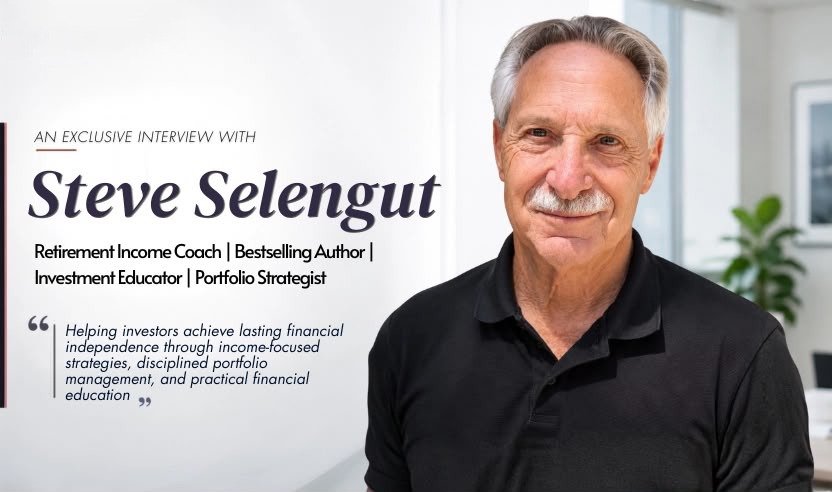
Steve Selengut: Transforming Retirement Investing Through Income, Experience, and Financial Independence
Retirement investing is often framed around one central question: How much is your portfolio worth? Steve Selengut has spent more than five decades encouraging investors to ask a different and, in his view, more practical question: How much income can your portfolio actually produce?
A veteran private investment portfolio manager, author, and retirement income coach, Steve Selengut has built his career around a philosophy that places spendable investment income at the center of retirement planning. Over more than 50 years in the investment world—including 44 years managing hundreds of individual portfolios—he developed and refined an income-focused approach designed to help investors generate cash flow while continuing to build and preserve working capital. He ultimately sold his investment management business in 2023 after managing more than $100 million in assets.
Today, Steve’s professional mission has evolved from managing portfolios directly to educating investors and financial professionals about income-focused retirement investing. Through The Retirement Income Coach, his writing, coaching, educational programs, and Retirement Money Secrets, he shares the principles developed through decades of hands-on experience.
His philosophy can be summed up by a fundamental distinction: wealth is not simply what an investment account is worth—it is also what that capital can produce for the life its owner wants to live.
A Career Forged Through More Than Five Decades of Investing
Steve Selengut’s investment career began more than 50 years ago, long before today’s digital investment platforms transformed access to financial markets.
Over the decades, he developed extensive experience as a private investment portfolio manager, ultimately managing approximately 300–325 individual portfolios at a time for clients in the United States and abroad. This hands-on experience became one of the defining features of his professional identity. Unlike many investment authors who primarily study or comment on markets, Steve spent decades making investment decisions for real clients and managing real portfolios through changing market environments.
That experience exposed him to one of the most persistent challenges facing retirees: accumulating assets is only part of the retirement equation. Once employment income disappears, investors need their portfolios to become sources of spendable cash flow.
Steve’s career therefore became increasingly focused on the relationship between investment capital and the income that capital can generate.
The Question That Changed His Approach to Retirement
Traditional investment conversations often revolve around portfolio appreciation, total returns, and account balances.
Steve believes those measurements can obscure a crucial reality for retirees.
A portfolio can have substantial market value and still fail to produce enough income to comfortably support its owner. Conversely, a portfolio designed around income generation can provide a recurring stream of cash flow that may allow an investor to meet expenses without continually selling investments.
This distinction became central to Steve’s investment philosophy.
Rather than viewing retirement primarily as a period in which investors gradually liquidate their accumulated assets, he developed an approach centered on creating portfolios that generate income while maintaining working capital.
His own retirement has become a personal example of this philosophy. Steve explains that his lifestyle is supported by portfolio-generated cash flow rather than by simply following a fixed annual liquidation strategy.
For him, retirement investing is therefore not merely about reaching a particular portfolio value. It is about creating an income-producing financial system capable of supporting a desired lifestyle.
From Wealth Accumulation to Income Independence
The concept of income independence sits at the center of Steve Selengut’s work.
Financial independence is often defined as having enough accumulated wealth to stop working. Steve takes the concept a step further by emphasizing whether invested capital can produce enough ongoing income to fund life after employment.
That distinction changes the way a retiree evaluates a portfolio.
Instead of focusing exclusively on whether an account has appreciated, an income-focused investor asks:
How much cash flow is this portfolio producing?
Is that income sufficient to cover my lifestyle?
Can the income grow over time?
Can the portfolio continue functioning through different market environments?
These questions form the foundation of Steve’s educational mission and his approach to retirement investing.
The Working Capital Model
One of Steve’s proprietary concepts is the Working Capital Model, which reflects his belief that portfolio principal should be treated as productive capital rather than simply as money waiting to be withdrawn.
Under this philosophy, investment capital is intended to perform two roles: generating current income and providing the foundation for future income growth.
Steve’s objective is not simply to maximize today’s distribution. Instead, his approach emphasizes the relationship between income generation, portfolio management, reinvestment, market conditions, and long-term working capital.
This philosophy grew directly from his decades of managing private portfolios and observing how different securities behaved throughout market cycles. The Working Capital Model remains one of several proprietary concepts associated with his income-focused investment methodology.
The Closed-End Fund Advantage in His Investment Philosophy
Closed-end funds occupy a particularly important position in Steve’s investment methodology.
Throughout his career, he used hundreds of closed-end funds as income-producing vehicles within portfolios. Their structure, distributions, market pricing, and potential discounts or premiums to underlying asset values provided opportunities that Steve incorporated into his approach to income-focused portfolio management.
Steve’s philosophy does not treat closed-end funds simply as another investment category. Instead, he views them as potentially useful components of an income-generating portfolio when carefully evaluated and managed.
His work has consequently become closely associated with educating investors about closed-end funds and their potential role in retirement income strategies.
Through his books, courses, interviews, and coaching, Steve explains how he evaluates income-producing securities and how market fluctuations can potentially create opportunities for income-focused investors.
Making Market Volatility Work Differently
For many retirees, market volatility represents one of the greatest sources of financial anxiety.
A falling market can create a psychological conflict: investors need money to live, but selling securities after prices have fallen can reduce the capital available for future recovery.
Steve’s philosophy approaches volatility from a different perspective.
Rather than automatically treating every decline as a threat, he teaches investors to understand how price fluctuations can create opportunities for an income-focused portfolio. His methodology emphasizes active management, market cycles, and the possibility of using changing valuations and interest-rate conditions to improve future income.
This does not mean eliminating investment risk or assuming that income is guaranteed. Instead, Steve’s approach is about changing the investor’s relationship with volatility.
A market decline may affect portfolio prices, but an income-focused investor can evaluate whether the underlying income-producing assets continue to fulfill their role.
That distinction is fundamental to Steve’s investment philosophy.
Income-Focused Retirement Investing
Steve refers to his broader methodology as Income-Focused Retirement Investing, or IFRI.
The approach emphasizes income-producing, stock-market-based securities, active management, and the potential to use market fluctuations and interest-rate changes as part of the portfolio-management process.
The objective is to shift the investor’s attention away from constantly monitoring market values and toward building a growing stream of spending money.
For retirees, this can represent a significant psychological change.
Instead of waking up each morning wondering whether the market has risen or fallen, investors can focus more directly on whether their portfolio is producing the income needed to support their lifestyle.
Steve’s broader message is that retirement portfolios should be designed around the purpose they are expected to serve.
If the purpose is to fund retirement, then the ability to produce retirement income deserves to be at the center of the conversation.
A Philosophy of Growing Income and Assets
Steve’s methodology is not based on choosing between income and growth.
One of its central ideas is that income and working capital can potentially grow together.
During his career, Steve explains that he frequently reinvested portfolio income that was not required for immediate spending. This created the potential for additional income-producing capital, which could then generate additional income in the future.
The concept creates a compounding cycle:
Income generates capital. Capital generates income. Reinvested income can create additional income-producing capital.
For investors still building wealth, this approach can provide a framework for thinking about how today’s portfolio income may contribute to tomorrow’s financial independence.
For retirees, it provides a framework for considering how excess income might be reinvested rather than automatically spent.
Retirement Money Secrets
Steve Selengut’s investment philosophy is presented most comprehensively in his book, Retirement Money Secrets: A Financial Insider’s Guide to Income Independence.
The book is designed to challenge the traditional emphasis on portfolio market value and encourage investors to focus more heavily on the production of spendable income. Steve draws on decades of experience managing private portfolios to explain how investors can think differently about retirement cash flow, market volatility, and income-producing investments.
The book has become a central part of Steve’s educational mission. According to his website, Retirement Money Secrets received the 2025 American Legacy Book Award in Personal Finance / Investing and has been consistently positioned as a leading book in the portfolio-management category.
Rather than presenting retirement as a mathematical exercise based solely on withdrawal percentages, Steve uses the book to introduce readers to an alternative mindset: building a portfolio around income and treating market volatility as something that can potentially be used rather than feared.
Teaching Investors to Measure What Matters
One of Steve’s strongest contributions is not a particular security or investment product. It is the way he encourages investors to evaluate their portfolios.
He challenges investors to distinguish between market value and realized income.
Market value can rise and fall every day. It is a measurement of what securities might be worth at a particular moment.
Income, however, is what an investor can potentially use to pay expenses.
For retirees, this distinction can be especially important.
Steve encourages investors to ask their financial professionals how much income their portfolios are actually producing and whether their investment strategy is designed to increase that income over time.
The goal is not to suggest that market value is irrelevant. Rather, Steve argues that retirees should ensure their portfolios are evaluated according to the financial purpose those portfolios are intended to serve.
A Hands-On Perspective Rarely Found in Investment Publishing
Steve’s background gives his educational work a distinctive foundation.
He is not simply an author explaining investment concepts from a theoretical perspective. He spent decades directly managing money for individual clients.
His experience includes managing approximately 300 or more individual portfolios simultaneously and working with investors through multiple market environments.
That practical experience influences the way he teaches.
Steve focuses on questions that investors encounter in real life: How much income will the portfolio produce? How should volatility be handled? How can income potentially grow? How should working capital be managed? How can retirees avoid becoming unnecessarily dependent on selling assets to pay expenses?
These are the questions that shaped his career and now shape his coaching.
From Managing Portfolios to Coaching Investors
After selling his investment management business in 2023, Steve entered a new chapter.
Instead of continuing to manage hundreds of portfolios directly, he shifted his attention toward coaching and education. His mission became helping individuals and financial professionals understand the income-focused principles he had spent decades developing.
This transition represents a natural evolution of his career.
For more than four decades, Steve applied his methodology directly to client portfolios. Today, he focuses on transferring that knowledge to investors who want to better understand income-focused investing and to advisors who want to explore how income generation can become a greater part of their clients’ retirement strategies.
His coaching work is educational in nature, with an emphasis on helping investors understand concepts, evaluate portfolios, and communicate more effectively with their existing financial professionals.
Helping Investors Work With Their Existing Advisors
Steve’s approach does not require every investor to abandon professional financial advice.
Instead, his coaching philosophy can be used to help investors have more informed conversations with the professionals already managing their money.
He encourages investors to understand the income their portfolios generate, question how that income is expected to evolve, and determine whether their portfolio structure is aligned with their retirement objectives.
This reflects one of Steve’s broader beliefs: investors should understand what their money is doing.
Financial professionals may manage the technical details, but investors should still be able to explain how their portfolios are intended to support their lives.
Building a Framework Around Income, Risk, and Diversification
Income generation alone is not enough.
Steve’s methodology also incorporates risk minimization and diversification as important elements of portfolio construction. His educational material explores how different securities and strategies can contribute to an income-oriented portfolio while addressing the risks associated with market cycles and changing financial conditions.
This is important because a high distribution rate by itself does not automatically make an investment appropriate.
Steve’s philosophy is better understood as a complete portfolio-management framework—one that considers income production alongside diversification, valuation, market conditions, portfolio construction, and working capital.
The objective is to create a portfolio designed for a purpose rather than simply assembling investments based on popularity or recent performance.
Proprietary Concepts Built From Experience
Over the course of his career, Steve has developed several proprietary concepts that form the foundation of his educational framework.
Among them are QDI + PT, Smart Cash, The Working Capital Model, The Investor’s Creed, Base Income, and the Investment Grade Value Stock Identification System.
These concepts reflect the evolution of his thinking across decades of portfolio management.
Rather than relying on a single investment rule, Steve has built a system intended to help investors think systematically about income, security selection, cash management, portfolio structure, and long-term financial objectives.
Creating a New Conversation Around Retirement
Steve’s work ultimately addresses a broader issue within retirement planning.
Many investors spend decades accumulating assets but may never receive clear guidance about how those assets should function once retirement begins.
The transition from accumulation to distribution can therefore become one of the most important—and most difficult—financial transitions of a person’s life.
Steve believes the conversation should begin earlier.
Instead of waiting until retirement to ask how investments will fund expenses, investors can begin building income-producing capacity during their accumulation years.
This creates a bridge between wealth creation and retirement income.
The portfolio built during a person’s working years can gradually evolve into the financial engine that supports life after employment.
A Mission Driven by Retirement Security
Steve’s motivation is deeply connected to what he sees as a widespread retirement challenge: people reaching retirement with substantial investments but insufficient dependable income.
He has described his frustration with retirees who are forced to sell investments to meet ordinary expenses, particularly when doing so can reduce the capital available for future income generation.
His response has been to dedicate the next chapter of his career to education.
Through Retirement Money Secrets, coaching, courses, interviews, newsletters, and educational resources, Steve is attempting to make income-focused investing more understandable and accessible to a broader audience.
His mission is not simply to teach investors how to select securities.
It is to change the way they think about retirement wealth.
The Start of a New Generation of Income Investors
Steve’s educational work also extends beyond people already approaching retirement.
His philosophy can be applied earlier in an investor’s financial journey, when there is still time to build and reinvest portfolio income.
By introducing younger investors to the concept of income independence, Steve seeks to encourage a mindset in which investment portfolios are viewed as future income-producing assets rather than merely accounts that must eventually be liquidated.
This long-term perspective can change how investors think about dividends, distributions, reinvestment, market cycles, and capital allocation.
The ultimate objective remains the same: build financial resources that can eventually support greater freedom and independence.
A Teacher as Much as an Investor
Steve Selengut’s career has gradually moved from portfolio management toward financial education.
Today, his role is not simply that of a former investment manager. He is an author and coach attempting to translate decades of market experience into a framework that everyday investors can understand.
His courses and educational programs expand upon the principles introduced in Retirement Money Secrets, including the use of closed-end funds, income generation, portfolio construction, and market volatility. His current educational series, Start the F.I.R.E.: Create a Growing Income Engine, is designed to bring those concepts into a structured learning environment.
This educational emphasis reflects Steve’s belief that investors become more confident when they understand not only what they own, but why they own it.
A Different Definition of Retirement Success
For Steve, retirement success is not necessarily defined by the size of an investment account.
It is defined by what that account can provide.
A successful retirement portfolio, in his philosophy, should ideally produce enough income to help support the owner’s lifestyle while preserving the capital necessary to continue producing future income.
That perspective transforms the portfolio from a static balance sheet number into an active financial resource.
It becomes an income engine.
It becomes a source of independence.
And, ultimately, it becomes a tool for allowing retirees to spend more time focusing on their lives rather than worrying about whether they will have enough money to live them.
Looking Toward the Future of Retirement Investing
Financial markets will continue to change.
Interest rates will move. Equity prices will rise and fall. Economic cycles will come and go. Inflation will create new challenges, and retirees will continue to face uncertainty about how long their assets must last.
Steve’s philosophy is built around preparing investors for that uncertainty rather than pretending it can be eliminated.
His emphasis on income production, active portfolio management, diversification, market cycles, and working capital provides a framework for thinking about retirement through different market environments.
The central idea remains remarkably consistent: investors should understand how their portfolios produce the money they actually spend.
A Legacy Built on Experience and Income Independence
Steve Selengut’s journey spans more than five decades of investment experience.
From his years as a private portfolio manager to managing hundreds of client portfolios, from building an investment management business with more than $100 million in assets to selling that business in 2023, his career has been defined by direct experience in the markets.
Today, he is applying that experience to a broader mission.
Through The Retirement Income Coach, Steve is helping investors reconsider what retirement wealth should mean. His work encourages people to move beyond the simple pursuit of market-value appreciation and examine whether their portfolios are capable of producing meaningful, sustainable income.
His philosophy does not suggest that investing can be made risk-free or that income is guaranteed. Instead, it offers a different framework for thinking about retirement: build around income, understand your investments, manage working capital thoughtfully, use diversification, and treat market volatility as something to understand rather than automatically fear.
That philosophy is captured in the central message behind his work: market value tells you what your portfolio may be worth; income tells you what your portfolio can help you do.
Through his books, coaching, educational programs, and decades of investment experience, Steve Selengut continues to champion a retirement philosophy built not merely around accumulating wealth, but around transforming invested capital into an ongoing source of financial independence.
As Steve’s own philosophy puts it, “Market value fuels the ego, income fuels the yacht.”
For Steve Selengut, that is more than a memorable investing phrase. It represents the core of a career dedicated to helping investors think differently about retirement—less about watching the value of their money fluctuate, and more about building financial assets capable of supporting the life they worked to create.
Educational note: The Retirement Income Coach LLC and Steve Selengut state that their coaching services are intended to provide educational insights and guidance and do not constitute professional investment advisory services. Individuals remain responsible for their own investment decisions.

 USA
USA Pune
Pune