
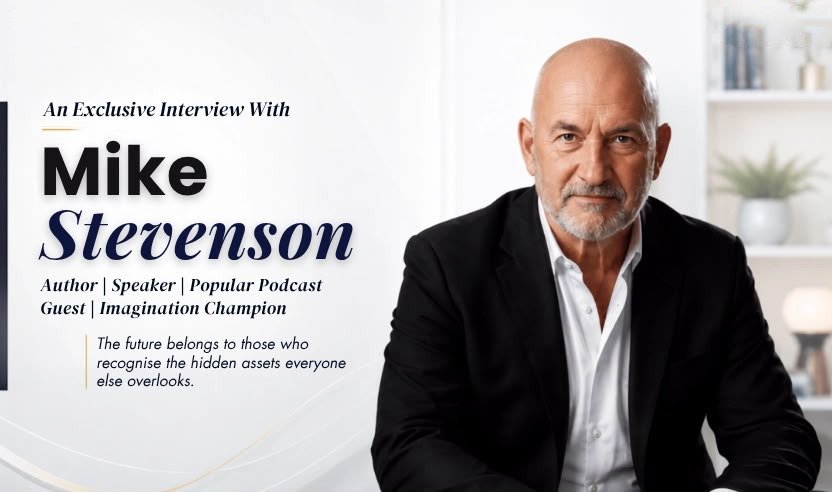
There are careers that follow a predictable path and then there are lives that become powerful precisely because they refuse to follow one. Mike Stevenson belongs firmly in the second category. His journey from being expelled from school at 15 with no qualifications, experiencing homelessness on the streets of London, battling addiction, and working 29 different jobs to eventually becoming a successful entrepreneur, award winning community leader, TEDx speaker, media commentator, and sought after keynote speaker is a remarkable story of resilience and reinvention.
Yet what makes Mike’s story particularly compelling is not simply the distance he has travelled. It is the way he has transformed difficult experiences into insight, adversity into empathy, uncertainty into opportunity, and personal success into a platform for helping others. Today, through his work as the founder of Thinktastic and as a keynote speaker, Mike challenges business leaders, organizations, teams, and individuals to reconsider the assumptions that limit them and to recognize the possibilities that emerge when people are willing to think differently.
His career has taken him through some extraordinary environments. He has worked as a steelworker, musician, actor, entrepreneur, business leader, and creative strategist. He has worked with major organizations including M&S, Sky TV, British Gas, and Standard Life. His work in business and community development has received significant recognition, including being named a three time winner of the Business in the Community Award for Raising the Attainment of Young People. Thinktastic was voted Scottish Small Company of the Year, while Mike himself received the inaugural Community Mark, awarded to only 21 UK company directors.
He has also brought his ideas to much larger audiences through TEDx, Leadercast, television, radio, newspapers, corporate conferences, and leadership events. His TEDx talk, “Dour to Doer,” captures an important part of his philosophy: the movement from passive acceptance toward purposeful action.
At the heart of everything Mike does is a simple but powerful belief. Circumstances can influence a person’s life, but they do not have to determine its destination.
A Beginning That Could Have Defined Everything
Mike Stevenson’s early life was far removed from the corporate boardrooms and conference stages where he would eventually build his reputation.
Expelled from school at just 15, he left formal education without qualifications. Instead of entering a conventional professional pathway, he experienced a period of profound instability that eventually led to homelessness on the streets of London. He also struggled with addiction during those years.
For many people, experiences of this kind can become defining barriers. They can create a sense that opportunities belong to other people and that circumstances have already determined what the future will look like.
Mike’s life took a different direction.
The difficulties he experienced did not disappear, nor can they simply be reduced to an inspirational story. They became part of his understanding of people, society, opportunity, and personal responsibility. His experiences gave him an unusual ability to understand what it feels like to be excluded, underestimated, uncertain about the future, or unable to see a clear path forward.
That perspective would eventually become one of his greatest strengths as a leader and speaker.
Rather than presenting resilience as an abstract corporate concept, Mike speaks about it from experience.
He knows what it means to start again.
He knows what it means to have very little.
He knows what it means to be judged by circumstances.
And he knows what it means to create an entirely different chapter.
Finding a New Direction Through Music and Experience
Mike’s journey eventually took him to Dublin, where he became immersed in the city’s music and cultural environment.
The move exposed him to an entirely different world and brought him into contact with influential figures within the Irish music scene, including Phil Lynott and Brian Downey. It was also a period shaped by the political tensions and unrest of the time, giving Mike further exposure to the complexity of society and the very different worlds people can inhabit.
His life continued to move through unexpected directions.
By his mid twenties, Mike had already worked 29 different jobs. His experiences included working in the steel industry, performing as a musician, acting, and taking on a wide variety of other roles.
A conventional career adviser might have viewed such a history as fragmented.
Mike’s later career suggests the opposite.
Those experiences gave him an unusually broad understanding of people and work. He learned to adapt to different environments, communicate with different personalities, understand different organizational cultures, and continually develop new skills.
Every job became part of his education.
Every transition taught him something.
Every unfamiliar environment required him to adapt.
What initially looked like a lack of direction eventually became a foundation for one of his defining qualities: the ability to see possibilities where others might see limitations.
From Reinvention to Entrepreneurship
The entrepreneurial chapter of Mike’s career marked a major turning point.
He founded Thinktastic, building a company around creativity, innovation, and the ability to help organizations approach challenges differently. The business went on to work with major brands including M&S, Sky TV, British Gas, and Standard Life.
The success of Thinktastic demonstrated that Mike’s unconventional background was not a weakness in the business world. In many respects, it was an advantage.
He understood that organizations often become constrained by the assumptions they make about themselves. Established processes can become habits. Successful strategies can become outdated. Teams can become comfortable with familiar approaches even when their markets are changing.
Creativity, in Mike’s view, provides a way to challenge those assumptions.
But creativity alone is not enough.
The real value lies in turning ideas into action.
Thinktastic’s work reflected that principle by combining unconventional thinking with practical organizational outcomes. The company was subsequently voted Scottish Small Company of the Year, providing recognition of its ability to turn creative thinking into a successful business.
Seeing Creativity as a Leadership Capability
Mike’s understanding of creativity extends far beyond traditional definitions.
Creativity is often associated with artists, musicians, designers, or advertising professionals. Mike’s career demonstrates a much broader interpretation.
For him, creativity is a way of thinking.
It is the willingness to ask a different question.
It is the courage to challenge an established assumption.
It is the ability to imagine an alternative when the obvious solution no longer works.
And it is the discipline to turn that alternative into something practical.
This perspective is particularly valuable for organizations operating in uncertain markets.
Companies can no longer rely entirely on what worked in the past. Technology changes customer expectations. New competitors emerge. Business models evolve. Employees expect different forms of leadership. Markets can change faster than organizational structures.
Under these conditions, creativity becomes more than an innovation department’s responsibility.
It becomes a leadership requirement.
The Experiences That Shaped His Leadership Philosophy
Mike’s leadership philosophy cannot be separated from his personal history.
His experiences have given him a strong understanding of the relationship between adversity and potential. He has seen how quickly circumstances can alter a person’s opportunities, but he has also experienced firsthand how quickly a person’s trajectory can change when they find the right opportunity, environment, or motivation.
That understanding has influenced his work with young people.
Mike has spent many years supporting initiatives designed to raise the attainment and aspirations of young people. His commitment was recognized through three Business in the Community Awards for Raising the Attainment of Young People.
The recognition is particularly meaningful given his own educational history.
Mike knows what it feels like to be told, directly or indirectly, that your potential is limited.
His work challenges that assumption.
He believes that young people should not be defined solely by their academic results, their background, or the circumstances in which they grow up.
Potential can take many forms.
Sometimes it appears late.
Sometimes it exists outside traditional systems.
And sometimes it requires someone else to recognize it before the individual can recognize it themselves.
Business Success and Social Responsibility
Mike’s career also demonstrates that commercial success and social contribution do not need to exist separately.
His work with major brands established his business credibility, while his community work established another dimension of his leadership.
He received the inaugural Community Mark, an award recognizing community engagement among UK company directors, and was also recognized through the New Start Magazine Better Places Award.
These achievements reflect his belief that businesses have responsibilities that extend beyond financial performance.
Companies influence communities.
Leaders influence people.
And successful organizations have the ability to create opportunities that extend beyond their immediate commercial objectives.
Mike’s own career demonstrates how business expertise can be used to address wider social challenges.
A Different Kind of Keynote Speaker
Mike’s evolution into keynote speaking was a natural extension of his experience.
He had spent years building businesses, working with major organizations, speaking about innovation, supporting communities, and navigating adversity. Eventually, the lessons contained within those experiences became the foundation for a broader message.
What distinguishes Mike from speakers who rely primarily on motivational language is the authenticity behind his story.
He does not need to invent an example of adversity.
He has experienced it.
He does not need to manufacture a story about reinvention.
His entire career is one.
He does not need to explain the importance of uncertainty from a theoretical perspective.
He has spent much of his life navigating it.
That authenticity gives his presentations an unusual emotional depth.
From Dour to Doer
Mike’s TEDx talk, “Dour to Doer,” captures the essence of his philosophy.
The phrase represents a transition from simply experiencing circumstances to actively responding to them.
That distinction is central to Mike’s approach.
People cannot always control what happens to them.
Organizations cannot control every change in their markets.
Leaders cannot predict every disruption.
But they can control how they respond.
The shift from passive reaction to purposeful action can transform the way individuals and organizations approach uncertainty.
It changes the question from “Why is this happening to us?” to “What can we do about it?”
That shift may appear simple, but it can have profound consequences.
Leading When the Future Is Uncertain
Modern leadership increasingly takes place in conditions of uncertainty.
Technology is changing industries at extraordinary speed. Artificial intelligence is altering established business models. Customers are changing how they discover, purchase, and interact with brands. Employees expect greater flexibility, meaning, and involvement. Economic conditions can shift rapidly.
In such an environment, traditional leadership approaches can become insufficient.
Leaders cannot always wait for certainty.
They need to make decisions with incomplete information.
They need to experiment.
They need to accept that not every decision will produce the intended outcome.
And they need to build teams that are comfortable with change rather than threatened by it.
Mike’s life provides a powerful example of this mindset.
His career was never built around certainty.
It was built around movement.
Courageous Decision Making
A recurring theme in Mike’s speaking is the importance of courage.
Organizations often know that something needs to change but hesitate because change carries risk.
Leaders may fear failure.
Teams may fear losing established roles.
Companies may fear damaging successful products or processes.
Yet avoiding change is itself a decision, and sometimes a much riskier one.
Mike encourages leaders to develop the confidence to make bold decisions when circumstances require them.
This does not mean taking reckless risks.
It means being willing to move beyond comfort.
It means asking whether established practices are still serving the organization.
It means recognizing when the cost of doing nothing has become greater than the risk of doing something different.
The Role of Failure in Growth
Mike’s personal story also challenges the way failure is viewed.
His life includes setbacks that could easily have been interpreted as evidence that success was impossible.
Instead, those experiences became lessons.
Failure taught him adaptability.
Adversity taught him empathy.
Uncertainty taught him resourcefulness.
Different careers taught him versatility.
Entrepreneurship taught him responsibility.
And public speaking gave him a platform through which those lessons could be shared.
This is particularly relevant for businesses seeking to create innovative cultures.
If employees believe that every unsuccessful experiment will be punished, they will eventually stop experimenting.
Innovation requires the freedom to test ideas.
Leadership requires the ability to learn from what does not work.
And progress requires the willingness to try again.
The Human Dimension of Organizational Change
Mike’s approach to leadership is not solely focused on strategy.
It is deeply human.
Organizations are made up of people, and people do not experience change as an abstract business process.
They experience uncertainty personally.
They worry about their roles.
They question their abilities.
They wonder whether they will succeed in a new environment.
They may resist change because they fear losing something familiar.
Effective leaders therefore need to understand the emotional side of transformation.
Mike’s own experiences give him a particularly strong appreciation of this reality.
He understands that people need more than instructions.
They need belief.
They need encouragement.
They need the opportunity to contribute.
And sometimes they need someone to remind them that their current circumstances are not the final definition of their potential.
A Career Built on Communication
Mike has developed an extensive communication career alongside his entrepreneurial work.
He has appeared as a media commentator on leadership, innovation, and business issues and has contributed as a columnist for The Sunday Times.
He has delivered Leadercast presentations and hosted Disney Institute Masterclasses, demonstrating his ability to communicate ideas to professional audiences in structured learning environments as well as through keynote storytelling.
His experience across different forms of communication has helped him develop a style that combines energy, humor, honesty, and practical insight.
Rather than presenting leadership as something distant and complicated, he makes it personal.
That is one of the reasons his message can connect with audiences ranging from senior executives to students.
The Power of Storytelling
Mike’s greatest communication asset may be his ability to tell a story.
People remember information, but they remember stories differently.
A story creates context.

 USA
USA Pune
Pune