
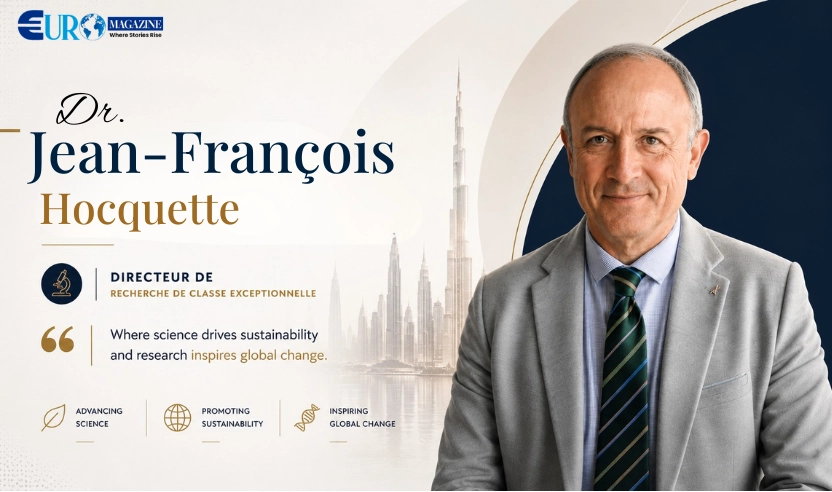
A Scientific Journey Rooted in Purpose
For Dr. Jean-François Hocquette, the journey into food science began with a deep curiosity about agriculture and the systems that nourish societies. With an early ambition to become an agricultural engineer, he pursued advanced studies in agronomy, endocrinology, and animal nutrition before joining INRAE, France’s National Research Institute for Agriculture, Food and the Environment. Over the decades, his scientific path evolved into a mission centered on one of the defining challenges of modern society: shaping sustainable and responsible food systems for the future.
Today, as “Directeur de Recherche de Classe Exceptionnelle” at INRAE, he combines scientific rigor with a broader societal perspective, focusing on the intersection of food quality and sustainability. His work reflects a holistic vision of food systems where scientific advancement must also align with human values, ethical considerations, and cultural realities.
Throughout his career, Dr. Hocquette has consistently emphasized that food cannot be reduced to simple nutrient intake or industrial efficiency. Instead, he views food as an essential part of culture, pleasure, health, and social connection. This perspective has shaped his long-standing commitment to building integrated frameworks that reconcile consumer expectations, agricultural sustainability, and scientific innovation.
Building a Holistic Framework for Sustainable Food Systems
One of the defining contributions of Dr. Jean-François Hocquette’s career has been his contribution to the development of the “One Quality” framework with his colleagues, an approach initially focused on eating quality and later expanded through the European INTAQT project. Rather than evaluating food through a single criterion, the framework promotes a multi-dimensional assessment system that considers among others sensory quality, consumer satisfaction, environmental impact, farm efficiency, nutrition, and animal welfare simultaneously.
This vision emerged from his recognition that the future of food systems requires balance rather than polarization. As global populations continue to grow and climate concerns intensify, he believes sustainable food production must remain scientifically grounded while also addressing ethical expectations and consumer trust.
His research has therefore focused on translating complex scientific data into practical tools capable of improving food systems at both industry and policy levels. By integrating different scientific disciplines and encouraging collaborative research, he has worked to establish more comprehensive ways of evaluating sustainability and food quality in real-world contexts.

 USA
USA Pune
Pune